

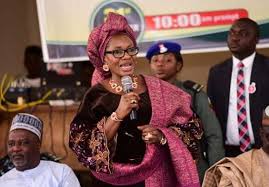
Dame Pauline Tallen, the minister of women’s affairs, stated on Friday that the new gender strategy will increase women’s political inclusion and involvement.
Tallen made this statement as the Development Partners Group on Gender, or DPGG, the Gender Equality Women’s Empowerment Coordination Strategic Framework 2023–2028, and the Presidential High-Level Advisory Council, or HLAC, were launched with partners.
She emphasized that without financial assistance, the potential of the documents’ releases would be hindered; as a result, the documents required solid and long-lasting financial support because “women are the backbone of our communities and our economies.”
She said; “This Strategy Note and Framework are a clear commitment from our development partners to fulfil a crucial accountability role and can improve the alignment and coordination of initiatives and actions taken in the interest of advancing gender equality and women’s empowerment in avoiding duplication of such efforts
“Following today’s launch, all efforts committed to their development will not go in vain and be allowed to gather dust on the shelves but should get the necessary buy-in from all our partners.
“I am confident that the successes we have recorded in the implementation of Nigeria for Women Project and the Agile project will be sustained as we prepare to scale them up to cover other States.
“We need to build a strong and resilient movement for progress towards attaining this and driving the Gender Agenda for Nigeria towards the empowerment of all women and girls, as well as the vulnerable.
“We have heard stories of women traders, who have been forced to shelve transformative business ideas because they could not access N200,000 from the financial system.
“In some instances, we heard stories of women smallholder farmers, who consistently receive less than one-tenth of the value of the high-value crops like coffee and shea butter; and even high-potential girls, who are consistently top of their class and aspire to build careers in science and technology, but have had to defer their dreams because “the boys have to go to School first”.
“As a way forward, we had to seek for ways to change these narratives resulting in the National WEE Policy and Action Plan being launched today.”
She claims that the Policy calls attention to important industries like agriculture, entrepreneurship, the traditional labor market, education, and skills, where the majority of Nigerian women and girls are employed or likely to seek careers.
The Minister further stated that, “The Policy also recognizes cross cutting enablers as Women’s Financial Inclusion, WFI, and Literacy, Digital Innovation, Literacy, Access, Household, Workplace, and Community Support Structures (norms change, access to care, labour saving solutions, PWDs, affinity groups), as well as issues of Gender-Responsive and Data-Driven Government Processes (e.g. policy making, budgeting, and procurement)
In a goodwill message, the Country Director, ActionAid Nigeria, AAN, Ene Obi, said, “As we launch this strategic note, let us remember that our work does not end here. It is merely the beginning of a collective effort to create a better future for all.
“It is a call to all stakeholders for action, all hands must be on board. We must hold ourselves accountable, monitor progress, and continuously adapt strategies to address emerging challenges.
“It is our collective responsibility to make sure that this all-important document will not remain on the shelf, as change can never happen except there is collective agency, ownership, and implementation of the set plans. These will in the long run make a huge impact on the lives of women and girls in Nigeria.”
Meanwhile, the United Nations Residents and Humanitarian Coordinator, Matthias Schmale, in a goodwill message said, “We want to overcome the dependence on humanitarian aid and I think that’s where women empowerment and women in agriculture will be fundamental.
“We all know, Nigeria can feed itself, and empowering women as key producers in the agricultural sector will lead to a situation where humanitarian aid is not needed. So we need to see that a policy will have a direct impact on other areas of our work, including our humanitarian work.”