News & Announcements Archives | Page 279 of 322 | The Lafete Magazine
close

News & Announcements

News & Announcements

Biden, Saudi Leader Speak Ahead Of Intelligent Report On Assassinated Journalist Khashoggi

President Joe Biden held a long-delayed first phone call Thursday with Saudi King Salman ahead of an imminent US intelligence report expected to link the Arab kingdom’s powerful crown prince to the killing of dissident journalist Jamal Khashoggi.

Biden kept the king waiting in his long list of calls to US allies after being sworn in five weeks ago.

And when he did finally reach out to the Saudis, it was pointedly to the king and not the expected successor Crown Prince Mohammed bin Salman, commonly known as MBS.

The telephone diplomacy was all part of what the White House is calling a reset in relations in the wake of Khashoggi’s horrific 2018 murder inside the Saudi consulate in Istanbul, Turkey.

US intelligence report on the incident, in which Khashoggi is believed to have been killed and then chopped into pieces, is being made public “soon,” the White House says.

It is expected to state that the crown prince in some capacity was connected to the killing, which involved a whole squad of Saudi agents positioned at the consulate before Khashoggi visited.

Khashoggi, a Saudi national who wrote for The Washington Post and was a US resident, had been an outspoken critic of the young prince.

The White House said that Biden and the 85-year-old king emphasized the countries’ security ties and “the US commitment to help Saudi Arabia defend its territory as it faces attacks from Iranian-aligned groups.”

However, in a shift from the Donald Trump era, Biden also “affirmed the importance the United States places on universal human rights and the rule of law.”

The Saudi state news agency said in its readout that the king and Biden stressed “the depth of the relationship between the two countries” and discussed Iran’s “destabilizing activities and its support for terrorist groups” in the region.

Human rights emphasis
Trump paid little attention to Saudi Arabia’s human rights violations. His son-in-law and Middle East adviser Jared Kushner became texting friends with 35-year-old Prince Mohammed.

Biden is likely to have his hands tied to some extent, because the reality is that MBS is lined up to take over Saudi Arabia and is already the de facto ruler. Typically, the United States does not impose sanctions on top-level foreign leaders.

With its vast oil reserves and rivalry with Iran, Saudi Arabia is also a vital strategic ally. A reminder of shared US and Saudi interests in the region came Thursday when the US military struck at facilities they said were being used by Iran-backed forces in Syria.

But the intelligence report’s publication, which could come as early as Friday, is a sharp departure in tone, reinforcing the administration’s policy of calling out Saudi Arabia on rights issues.

US Secretary of State Antony Blinken on Thursday had his own telephone call with Saudi Foreign Minister Faisal bin Farhan.

They “discussed the importance of Saudi progress on human rights, including through legal and judicial reforms,” State Department spokesman Ned Price said.

Prince Mohammed has said he accepts Saudi Arabia’s overall responsibility in Khashoggi’s killing but denies a personal link.

Sarah Leah Whitson, executive director of Democracy for the Arab World, an advocacy group founded by Khashoggi, said that Biden needed to take more concrete action.

“President Biden should now fulfill his promise to hold MBS accountable for this murder by, at minimum, imposing the same sanctions on him as those imposed on his underlying culprits and ending the weapons transfers to Saudi Arabia that would be controlled by an unelected, brutal murderer,” she said.

In Saudi Arabia, five people were handed death sentences over the murder. But a Saudi court in September overturned them while giving jail terms of up to 20 years to eight unnamed defendants following secretive legal proceedings.

Human rights advocates called the judicial process a whitewash aimed at blaming the hit men while not touching the mastermind.

CNN, quoting documents filed in a Canadian civil lawsuit, reported that two private jets used by the squad that allegedly flew to Istanbul to kill Khashoggi were owned by a company earlier seized by Prince Mohammed.

A respected veteran journalist and editor, Khashoggi was in self-exile and residing in the United States, writing articles critical of the crown prince when he was assassinated on October 2, 2018.

The 59-year-old writer had been told by Saudi Arabia’s ambassador to the United States to go to the Saudi consulate in Istanbul if he wanted to obtain documents for his forthcoming marriage.

There he was killed, and his body dismembered by a team sent from Riyadh under the direction of Prince Mohammed’s top security aide, Saud al-Qahtani.

read more
News & Announcements

How Cameroon Soldiers Raped 20 Women, Killed Man – HRW

Cameroonian soldiers raped at least 20 women, including four with disabilities, and killed a man in a raid last year in an English-speaking secessionist region, Human Rights Watch said Friday.

HRW said the attack against the village of Ebam, in the country’s southwest, was one of the worst the army has committed in its four-year battle with armed separatists.

A number of soldiers rounded up men, while others raped at least 20 women, including four with disabilities, the activist group said in a statement after speaking by phone to survivors and witnesses between August and January.

It added a 34-year-old man was killed by soldiers in a forest surrounding the village.

Witnesses were quoted as saying that more than 50 soldiers entered Ebam by foot before dawn on March 1 last year, in retaliation against civilians suspected of cooperating with separatist fighters, including offering them shelter.

In 2017, resentment over years of perceived discrimination at the hands of Cameroon’s francophone majority resulted in a declaration of independence by anglophone radicals.

Their self-declared state, Ambazonia, has not been recognised internationally, and the central government in Yaounde has responded with a crackdown.

“Sexual violence and torture are heinous crimes that governments have an obligation to immediately, effectively, and independently investigate, and to bring those responsible to justice,” said Ida Sawyer, deputy Africa director at Human Rights Watch.

“One year on, survivors of the Ebam attack are desperate for justice and reparations, and they live with the disturbing knowledge that those who abused them are walking free and have faced no consequences.”

The army declined to comment when contacted by AFP.

One 40-year-old woman told HRW that five masked soldiers entered her home.

“One of them abused me. He said: ‘If you don’t have sex with me, I will kill you!’. I was too afraid to say or do anything,” the woman told the rights group.

“After the rape, I ran into the bush where I spent two months. I am still upset and traumatised.”

None of the rape victims could receive medical care immediately after the attack partly because of cost of treatment and social stigma, said HRW, who nonetheless interviewed a doctor who later screened the women.

HRW also said that soldiers took at least 36 men to a nearby military base where they beat them and used violence that amounted to torture.

Villagers also reported soldiers stole money and other items from the homes they broke into.

Rights groups have accused both the separatists and government troops of having killed civilians during the separatist conflict since 2017.

The fighting has claimed the lives of more than 3,000 people and forced over 700,000 to flee their homes.

read more
News & Announcements

More Than 200 School Girls Missing As Bandits Attack School In Northern Nigeria

Several hundred girls are missing after unidentified gunmen raided a school hostel in the northwest Nigerian state of Zamfara, a teacher and parent told the AFP news agency, in the second mass kidnapping in the troubled region in little more than a week.

Sulaiman Tanau Anka, information commissioner for Zamfara State, however, told Reuters that it was not immediately clear how many children had been seized.

“Unknown gunmen came shooting sporadically and took the girls away,” Anka said. “Information available to me said they came with vehicles and moved the students, they also moved some on foot,” Anka said.

Security forces were hunting through the area, he added.

Earlier, a teacher at the Government Girls Secondary School Jangebe, who asked to remain anonymous, told AFP news agency that “more than 300 girls are unaccounted for” after the raid.

A parent told AFP he had received a call about the incident.

“I’m on my way to Jangebe. I received a call that the school was invaded by bandits who took away schoolgirls. I have two daughters in the school,” said Sadi Kawaye.

A police spokesman for the state did not immediately respond to calls and messages seeking comment.

“[According to local people] the gunmen arrived shortly midnight and operated for hours in this all-girls school in Zamfar state,” Al Jazeera’s Ahmed Idris reporting from Minna in Niger State said.

“This is one of the states that is continuously being attacked by these gunmen, abductions for ransom and raiding for villages … this is practically one of the major things that people in the north of the country are facing on a daily bases,” he added.

This is the second such kidnapping in a little more than a week in Nigeria’s north, which has seen a surge in activity by armed groups leading to a widespread and worsening breakdown of security.

Last week, unidentified attackers killed a student in an overnight attack on a boarding school in the north-central Nigerian state of Niger and kidnapped 42 people, including 27 students. The hostages are yet to be released.

More than 300 boys were kidnapped from a school in December in Kankara, in President Muhammadu Buhari’s home state of Katsina, while he was visiting the region.

The boys were later released after negotiations with government officials but the incident triggered global outrage.

read more
News & Announcements

Somalian Opposition Cancels Anti-Govt Protest

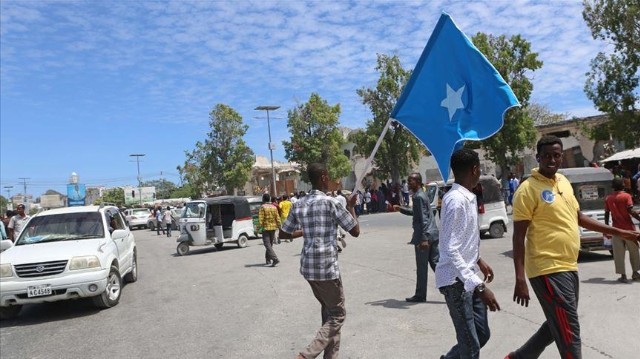
Somali opposition presidential candidates postponed an anti-government rally after Prime Minister Mohamed Hussein Roble and opposition leaders met Thursday in the capital Mogadishu. 

The demonstrations over delayed parliamentary and presidential elections, scheduled to be held Friday, were postponed after the federal government officially expressed regret over clashes last week in Mogadishu that left at least four people dead.

According to a communique issued after the meeting, the government agreed to the appointment of a committee to investigate the incident, sent its condolences to the people and presidential candidates and guaranteed the constitutional right of citizens to protest.

The opposition rally will now take place in 10 days, according to the communique.

The current political climate emerged after Somalia’s President Mohamed Abdullah Mohamed’s constitutional mandate expired on Feb. 8.

The opposition demanded the president to step down and that a transitional national council be appointed to manage the coming elections.

The latest development comes after Somalia’s civil society and traditional elders mediated between the government and opposition groups.

read more
News & Announcements

American Reveals How He Killed Neighbor, Cut Her Heart And Cook It For Meal

When police broke into Andrea Lynn Blankenship’s home in Chickasha, Oklahoma, on February 12, they found her body stabbed and her chest mutilated.

Earlier that day, the victim’s neighbour admitted to breaking into Blankenship’s home, cutting out her heart and taking it back to his uncle’s house, police said.

“He cooked the heart with potatoes to feed to his family to release the demons,” an agent with the Oklahoma State Bureau of Investigation said to a judge in a request for a search warrant, which was reviewed by the Oklahoman.

Washington Post reports that Lawrence Paul Anderson then allegedly killed his uncle and his uncle’s 4-year-old granddaughter in a gruesome case that has rocked the city of 16 400. Anderson, 42, was charged on Tuesday with three counts of first-degree murder and two felony charges of assault and battery with a deadly weapon and maiming, court records show.

Anderson was denied bond on Tuesday, and it’s not clear whether he made a plea. Lawyers for Anderson did not immediately respond to requests for comment late Tuesday.

Police have not said whether they suspect a motive in the slayings.

Police first learned of the crimes on Feb. 9, when they received a 911 call from someone inside the home of Leon Pye, Anderson’s 67-year-old uncle, OSBI said in a news release. Anderson had been staying with his uncle and aunt, 64-year-old Delsie Pye after Republican Oklahoma Gov. Kevin Stitt commuted his 20-year prison sentence. He was released on Jan. 18 after serving a little more than three years in prison, according to court records.

According to OSBI, the person who called the police quickly hung up, prompting the dispatcher to alert Chickasha Police. Once they arrived at the home, police heard someone inside yelling for help and then found Leon Pye and his 4-year-old granddaughter, Kaeos Yates, who was visiting for the day, dead. His wife, Delsie, was maimed with stab wounds in both eyes, KFOR reported.

Delsie and Anderson, who was also injured, were transported to a hospital for treatment, OSBI said.

While in custody in the hospital on February 12, Anderson admitted to killing Blankenship, 41, police said. Anderson said he had walked to her house and used his shoulder to slam into the back door to break it open. He then fatally stabbed her and “cut her heart out,” he later told OSBI agents. Then he walked to his aunt and uncle’s home, where he cooked it and tried to force them to eat it before attacking them, the Oklahoman reported.

After he recovered at the hospital, police transported Anderson on February 15 to Grady County Jail. Anderson is scheduled to return to court on April 1.

Anderson has a lengthy criminal past, court records show. He first went to prison in 2006 and served two years for possessing crack cocaine with the intent to distribute and for attacking his girlfriend and pointing a gun at her. In 2012, he returned to prison with a 15-year sentence for another crack cocaine distribution charge but was released early after less than six years. In 2017, he was sentenced to 20 years on drug charges and having a gun, which was in violation of his probation. That sentence was commuted by Stitt last June to nine years before he was again released early.

At a news conference on Tuesday, Grady County Republican District Attorney Jason Hicks condemned the governor’s commutation and blasted the parole board for letting Anderson out. “I really think an offender such as this should have not ever been able to even apply for a commutation,” Hicks said.

A spokesman for Stitt did not immediately return a request for comment.

Hicks added that the Oklahoma Department of Corrections warned in Anderson’s application that he was a “high risk to offend.”

Hicks also said that he is considering capital punishment.

“The death penalty is absolutely on the table,” he said.

In an interview with KFOR, Haylee Blankenship, Andrea Blankenship’s 18-year-old daughter, remembered her mother as caring and “filled with so much love.” Speaking for a family still in shock over the details of their loved one’s death, the younger Blankenship hopes the district attorney pursues the death penalty.

“I hope that he spends the rest of his life thinking about it until he gets his life taken, just like he took those people’s lives,” she said.

read more
News & Announcements

COVID-19: UN Agency Delivers AstraZeneca Vaccines To Ghana

The World Health Organization’s global vaccine sharing scheme Covax delivered its first Covid-19 shots on Wednesday, as the race to get doses to the world’s poorest people and tame the pandemic accelerates.

A flight carrying 600 000 doses of the AstraZeneca/Oxford vaccine produced by the Serum Institute of India landed in Ghana’s capital Accra, the World Health Organization (WHO) and the United Nations International Children’s Emergency Fund (UNICEF), said in a joint statement.

The delivery comes almost a year after the WHO first described the novel coronavirus as a global pandemic and eight months after the launch of the Covax initiative, aimed at pooling funds from wealthier countries and non-profits to develop a Covid-19 vaccine and distribute it equitably around the world.

The shots will be used to kick-start a vaccination drive that will prioritise frontline health workers and others at high-risk, according to a plan presented by Ghanaian health officials on Friday.

“This is a momentous occasion, as the arrival of the Covid-19 vaccines into Ghana is critical in bringing the pandemic to an end,” Anne-Claire Dufay of UNICEF Ghana, and WHO country representative, Francis Kasolo, said in the statement.

“These 600 000 Covax vaccines are part of an initial tranche of deliveries … which represent part of the first wave of Covid vaccines headed to several low and middle-income countries,” they said.

The roll-out in Ghana is a milestone for the initiative that is trying to narrow a politically sensitive gap between the millions of people being vaccinated in wealthier countries and the comparatively few who have received shots in less-developed parts of the world.

It aims to deliver a total of 2.3 billion doses by year-end, including 1.8 billion to poorer countries at no cost to their governments, and to cover up to 20% of countries’ populations. But it will not be sufficient for nations to reach herd immunity and effectively contain the spread of the virus.

The African Union (AU) has been trying to help its 55 member states buy more doses in a push to immunize 60% of the continent’s 1.3 billion people over three years. Last week, its vaccine team said 270 million doses of AstraZeneca, Pfizer and Johnson & Johnson vaccines secured for delivery this year had been taken up.

China has donated small batches of its Sinopharm vaccine to countries including Zimbabwe and Equatorial Guinea. And Russia has offered to supply 300 million doses of its Sputnik V vaccine to the AU scheme along with a financing package.

But many countries are largely reliant on Covax.

On Tuesday, WHO Director-General Tedros Adhanom Ghebreyesus urged wealthy nations to share vaccine doses with Covax, saying the goal of equitable distribution was “in jeopardy.”

“So far 210 million doses of vaccine have been administered globally but half of those are in just two countries,” Tedros said in Geneva. “More than 200 countries are yet to administer a single dose.”

Covax is co-led by the WHO, the GAVI vaccines alliance, the Coalition for Epidemic Preparedness Innovations (CEPI) and the United Nations children’s fund UNICEF.

It was launched in June 2020 to try to prevent poorer countries from being pushed to the back of the queue for Covid-19 vaccines as wealthier nations bought up billions of doses for their populations.

Covax said this month that it had allocated the first tranche of 330 million doses of vaccines for 145 countries, including several in West Africa.

read more
News & Announcements

Remains Of Italy Ambassador To DRC, His Bodyguards Arrive Rome

The bodies of Italy’s ambassador to the Democratic Republic of Congo and his bodyguard arrived back in Rome on Tuesday aboard a military aircraft, a day after they were shot dead following an ambush in eastern Congo.

Ambassador Luca Attanasio, 43, and his bodyguard Vittorio Iacovacci, 30, were killed while travelling in a United Nations’ World Food Programme convoy to visit a school feeding project. WFP driver Mustapha Milambo was also killed.

Italian Prime Minister Mario Draghi joined bereaved relatives as the plane carrying the coffins touched down at Rome’s Ciampino airport following the flight from the Congolese city of Goma, near the Rwandan border.

According to Congo’s presidency, the two-car convoy had been stopped on the road north from Goma by six armed men, who killed driver Milambo and led the six other passengers away. Army and park rangers tracked the group and a firefight ensued, during which the kidnappers shot the two Italians.

Congo’s interior ministry has blamed a Rwandan ethnic Hutu rebel militia called the Democratic Forces for the Liberation of Rwanda (FDLR) for the attack. The FDLR, one of around 120 armed groups operating in eastern Congo, denied responsibility for what it called a “cowardly assassination”.

“The FDLR declare that they are in no way involved in the attack,” the group said in a statement.

The local governor said that the assailants spoke the Rwandan language, Kinyarwanda.

The FDLR, founded by Rwandan former officers and militiamen who the United Nations and others blame for the 1994 genocide in Rwanda, has been blamed for previous kidnappings, including of two British tourists held for several days in May 2018.

President Felix Tshisekedi dispatched his top diplomatic adviser to Goma to support an investigation by local authorities, and a Congolese envoy in Rome would present a letter from Tshisekedi to Italian President Sergio Mattarella, Congo’s presidency said.

Italian Carabinieri police investigators have flown into Congo for a brief mission to liaise with police there, an Italian source told Reuters. When they return home, Italian prosecutors will open a full investigation, the source said.

Attanasio was the first-ever Italian ambassador to be killed while in service. Dario Tedesco, an Italian volcanologist based in Goma, paid tribute to his slain friend.

“He was able to talk to all of us, completely different because, he was adapting himself to each of us, (making) us feeling we were important,” Tedesco said. “He believed in what he was doing and this shouldn’t have been his final journey.”

read more
News & Announcements

Guinea Formerly Launches Ebola Vaccination Campaign

Guinea launched an Ebola vaccination campaign on Tuesday after a fresh outbreak of the deadly disease struck the country this month, with officials hoping to eradicate the virus in six weeks.

The country reported new Ebola cases on February 13  — the first in West Africa since a 2013-2016 epidemic that left more than 11,300 dead in Guinea, Liberia and Sierra Leone.

The latest outbreak emerged near the town of Gouecke, in the forested Nzerekore region in Guinea’s southeast, and has already killed five people.

No new cases have however been confirmed for a week.

Ebola causes severe fever and, in the worst cases, unstoppable bleeding.

It is transmitted through close contact with bodily fluids, and people who live with or care for patients are most at risk.

Health workers began to administer Ebola vaccines in Gouecke on Tuesday, after over 11,000 doses arrived in Guinea the previous day.

Guinea’s Health Minister Remy Lamah, as well as Georges Ki-Zerbo, the World Health Organization representative in the country, travelled to the town for the start of the rollout.

The WHO plans to send about another 8,000 doses to Guinea, the UN health agency said in a statement on Tuesday.

Health Minister Lamah told AFP: “I think that in six weeks, we can be done with this disease.”

During a ceremony outside a health centre in Gouecke, local government officials received jabs before a crowd of several dozen people. An imam and preacher also encouraged people to get immunised.

Lamah, who hails from the region, said he had spent the day trying to persuade local leaders to overcome their resistance to the vaccine.

Ki-Zerbo said the jabs would be administered mainly to those who had been in contact with people known to be infected, followed potentially by a second circle of people to break the chain of transmission.

The vaccination campaign also began in Dubreka on the outskirts of the capital Conakry, said Dr Halimatou Keita, who works in a hospital there.

On Wednesday, the rollout will continue in Nzerekore, located around 40 kilometres from Gouecke.

A total of 385 people have been identified as contacts linked to the initial case and that person’s relatives, said Bouna Yattassaye, deputy director of the National Agency for Health Security.

The vast majority of them are being monitored and will be among the first to be vaccinated.

Meanwhile, in central Africa, the Democratic Republic of Congo has also seen a new Ebola outbreak.

Officials said Sunday that four people had died while warning that people were resisting measures to contain the highly contagious disease.

read more
News & Announcements

15 UN Peacekeepers From Tigray Refuse To Return To Ethiopia

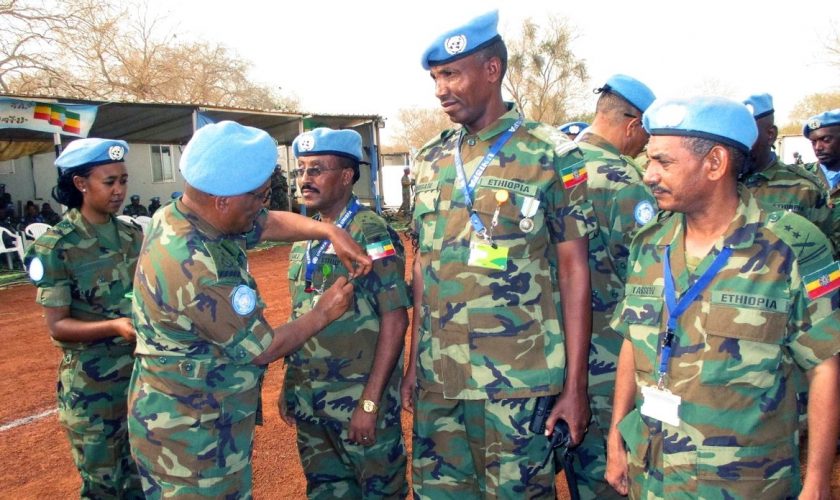
Fifteen members of a contingent of Ethiopian peacekeepers in South Sudan, originally from the Tigray region, refused to return to Ethiopia Monday, the UN said, citing their right to seek asylum if they fear for their lives.

Tigray has been the theatre of fighting since early November 2020, when Ethiopian Prime Minister Abiy Ahmed announced military operations against the Tigray People’s Liberation Front (TPLF), accusing them of attacking federal army camps.

He declared victory after pro-government troops took regional capital Mekele in late November, though the TPLF vowed to fight on, and clashes have persisted in the region, hampering efforts to deliver sorely-needed humanitarian assistance.

“This morning, 169 members of the Ethiopian contingent were due to rotate out of Juba and be replaced by fresh contingents, as part of a normal rotation,” said UN spokesman Stephane Dujarric during his daily press conference.

“We’re trying to get the details, but I do understand about 15 members of the contingent chose not to board the flight at the Juba airport… They’ve asked to stay,” he said, adding that “any person in need of international protection has the right to seek asylum.”

“They are receiving support from the South Sudanese Ministry of Refugee Affairs,” Dujarric continued, and the UN High Commissioner for Refugees (UNHCR) is “aware” of the situation and in contact with South Sudanese authorities.

The UNHCR defends the principle of “non-refoulment,” or allowing refugees or people seeking asylum not to return to their country of origin “if they feel their lives or freedom could be threatened,” Dujarric said.

read more
News & Announcements

G7 Nations Lash At Myanmar Army Over Extreme Force On Protesters

Myanmar’s military leaders came under renewed pressure Tuesday as the world’s wealthiest nations (G7) condemned the junta for responding to anti-coup demonstrators “with violence”, a rebuke coming on the heels of tightened sanctions from Washington and Brussels.

Authorities have gradually ratcheted up their use of force against a massive and largely peaceful civil disobedience campaign demanding the return of ousted leader Aung San Suu Kyi.

Three anti-coup protesters have been killed in demonstrations so far, while a man patrolling his Yangon neighbourhood against night arrests was also shot dead on the weekend.

“Use of live ammunition against unarmed people is unacceptable,” the foreign ministers of the G7 group of rich democracies — comprising Canada, France, Germany, Italy, Japan, Britain, the United States together with the EU — said in a statement Tuesday.

“Anyone responding to peaceful protests with violence must be held to account,” they said, calling for Myanmar security forces to “exercise utmost restraint and respect human rights and international law”.

The sharp condemnation comes after the overnight blacklisting of another two members of the regime by the United States — air force chief Maung Maung Kyaw and fellow junta member Moe Myint Tun — after announcing targeted sanctions against other top generals earlier this month.

“We will not hesitate to take further action against those who perpetrate violence and suppress the will of the people,” Secretary of State Antony Blinken said.

Hours before, the European Union had also approved sanctions targeting Myanmar’s military and their economic interests, with EU foreign policy chief Josep Borrell said that financial support to the government reform programmes is “withheld”.

Protesters continued staging rallies across Myanmar, though commercial hub Yangon saw much smaller numbers massing at key junctions on Tuesday.

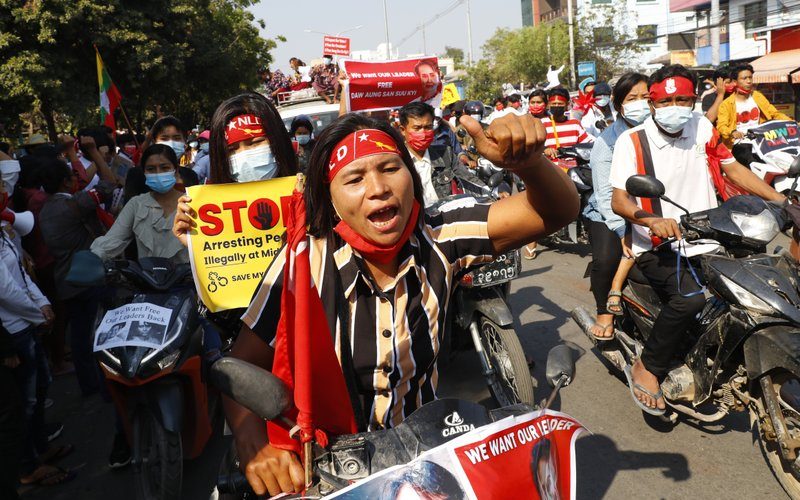
In the northern Kachin city of Myitkyina — which has seen bursts of violence from authorities — protesters rode their motorbikes across town waving Myanmar flag and flashing a three-finger salute, a symbol of resistance.

Mandalay saw a more sombre crowd at the funeral of Thet Naing Win, a 37-year-old man shot and killed Saturday when security forces opened fire into a crowd of anti-coup protesters.

“I beg for all to help see that my husband’s case is ruled with justice,” said his widow Thidar Hnin, adding that she wants to see “the dictator dethroned”.

“This country is owned by the citizens,” she told AFP.

More than 680 people have been arrested since the February 1 coup, according to the Assistance Association for Political Prisoners monitoring group, with nearly all still behind bars.

Overnight internet shutdowns have also become routine, fanning fears of anti-coup protester arrests during the blackouts.

In recent weeks, the Myanmar military has deployed tear gas, water cannon and rubber bullets against protesters, with isolated incidents of use of live rounds.

They have also stepped up the presence of security forces in Yangon, Myanmar’s largest city.

The crackdown has failed to quell weeks of massive street demonstrations, joined by large numbers of striking civil servants, bank staff and healthcare workers.

Tens of thousands rallied on Monday in the capital Naypyidaw, a military stronghold. More than 100 people were arrested as police chased protesters through the streets.

Demonstrators in Yangon ignored security forces and barricades set up around the city to hold impromptu vigils for protesters killed in the unrest.

“We can only pray for them,” said student Thura Myo. “Even when we are sad, our voices will be heard by the international community.”

The civil servants’ boycott has choked many government operations, as well as businesses and banks and at the weekend the junta gave its most ominous warning yet that its patience was wearing thin.

“Protesters are now inciting the people, especially emotional teenagers and youths, to a confrontation path where they will suffer the loss of life” said a message aired on state media.

Suu Kyi has not been seen since she was detained in a dawn raid but has been hit with two charges by the junta, one of them for possessing unregistered walkie-talkies.

Her hearing is expected on March 1.

read more
1 277 278 279 280 281 322
Page 279 of 322