
Junior physicians in England are on strike over pay dispute.

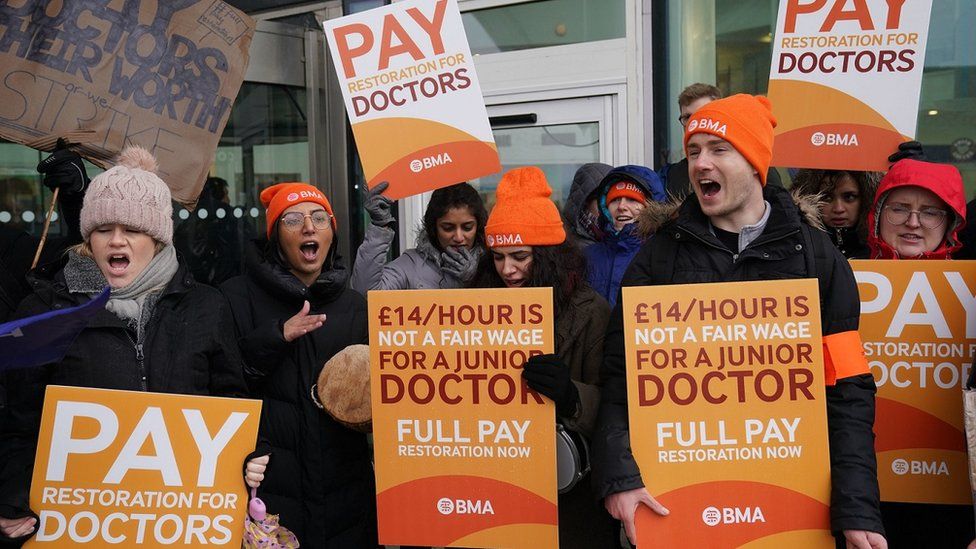
Thousands of junior doctors throughout England have joined the strike as the salary conflict with the British Government continues.
The 72-hour strike by doctors, who can have up to eight years of hospital experience or three years in general practice, continued until 7 a.m. (0600 GMT) on Saturday and is anticipated to result in the cancellation of hundreds of National Health Service appointments and procedures.
This most recent development comes after NHS leaders issued a warning that as the UK’s hot weather persisted, a greater proportion of people would need emergency assistance.
According to NHS officials, urgent and emergency care will continue to take precedence.
Junior physicians are on strike for the third time this year, and major disruptions are anticipated.
Concerns have also been raised concerning the availability of employees, with some consultants declaring that they would refuse to cover strikes unless their employers agreed to a higher overtime rate.
The British Medical Association is demanding the “full restoration” of salary, which has reportedly been reduced by 26%.
To resolve the conflict, the government has given 5%.
The co-chairmen of the BMA junior doctors committee, Drs. Vivek Trivedi and Robert Laurenson, stated in a statement that “young physicians are in despair at this government’s failure to listen.
“It should never have taken two whole rounds of strike action to even put a number on the table.
“And for that number to be a 5 per cent pay offer in a year of double-digit
inflation, itself another pay cut beggars belief.
“We have made it clear that junior doctors are looking for the full restoration of our pay, which has seen a 26 per cent cut,’’ it noted.
The junior doctors in England had seen their pay cut in real terms by more than a quarter over the last 15 years.
The statement added, “Today, they are demonstrating what that means to the survival of the NHS.”
53 percent of England’s 1,935 young physicians, according to a BMA survey released on Wednesday, are preparing to leave the NHS.
According to the poll, the government’s response to industrial action has caused the doctors to consider quitting.
Approximately 67% of people believe the NHS won’t exist in its current form in ten years, and 88% believe it will get worse over the next 18 months.
In the meantime, Prime Minister Rishi Sunak has received a letter from BMA Chairman of Council, Prof. Philip Banfield, pleading for him to get involved in mediating the conflict.
The BMA’s decision to continue its strike action was deemed “extremely disappointing” by Health and Social Care Secretary Steve Barclay.
He said: “this 72-hour walkout will put patient safety and our efforts to cut waiting lists at risk.
“During recent meetings with representatives of the BMA junior doctors committee, we made a fair and reasonable opening offer and were discussing both pay and non-pay issues until they chose to end the talks by announcing new strike dates.
“If the BMA cancels these damaging and disruptive strikes and shows willingness to move significantly from their positions, we can resume confidential talks and find a way forward, as we have done with other unions.”
On Wednesday, doctors will form picket lines in front of their hospitals, and the BMA would also hold rallies the remainder of the week.
This would make the protests in Oxford, Birmingham, London, and Manchester.
The NHS Confederation’s acute network director, Rory Deighton, expressed concern about the strike’s effects.
According to him, “The NHS has become used to managing the disruption caused by industrial action so patients should feel assured their local services are doing everything they can to prioritise “those with the greatest clinical need and provide safe services for patients.”
However, each wave of strikes chips away at the NHS’s resilience, impacting on staff, internal relationships, and their ability to deliver on government pledges to reduce the elective backlog.
“A particular challenge this time will be securing the level of consultant cover for absent junior doctors due to ongoing local negotiations on the overtime payments,” Deighton insisted.
He continued, “In reality, this means that it is still uncertain exactly how many planned procedures and appointments will need to be scaled back and rescheduled.
“The national advice remains that patients should assume their care will continue unaffected unless told otherwise.
“With the BMA having announced its intention to re-ballot its members for a mandate for a further six months of strikes, and with industrial action from consultants, radiographers and nurses possibility, the short-term outlook feels gloomy.
“A resolution is desperately needed, and we urge the government to search for a resolution to this dispute.”
The national medical director of NHS England, Prof. Sir Stephen Powis, stated earlier this week that the most recent strike might have some effect on practically all routine or planned care.
A similar junior doctor protest in April resulted in the rescheduling of 196,000 hospital appointments and scheduled operations.
Speaking on Wednesday, he said , “The NHS is facing significant disruption this week with a three-day strike that is set to be exacerbated by the ongoing hot weather.”
The numbers of people seeking emergency care are on the increase as temperatures rise.
“While thousands of appointments are likely to be rescheduled due to strike action, the NHS will continue to prioritise urgent and emergency care,” Powis alerted further.
But with the country in the midst of a heatwave, the public can play their part by being sensible in the warm weather.
He maintained, “For the vulnerable and elderly, this includes drinking plenty of water, using sunscreen and avoiding prolonged periods in the sun or swimming in unsafe water.
“Please do also consider checking in on any vulnerable friends, family members, or neighbours who may struggle with the heat and humidity.
“People with conditions such as asthma should continue to use their inhalers,” Powis concluded.


A vote for Raila Odinga will address Africa’s prosperity promptly.


Many Happy Returns To Princess Adeshewa Loveth


Dozens Trapped As Four-storey Building Collapse In Abuja


Rhema Voice Chapel International Sierra Leone Turns Sod To A Magnificent Church Building

