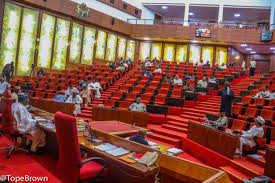
Senate confirms Buhari’s N22.7 trillion in extra-budgetary spending, causing outrage
Leading economists, the Nigeria Employers’ Consultative Association, and opposition groups criticized President Major General Muhammadu Buhari (ret.) and the Senate for the N22.7 trillion in extra-budgetary spending that was approved by the upper legislative house on Wednesday.
Economic experts viewed the Senate’s approval of the loan as uncommon in separate interviews with The PUNCH, despite the fact that organizations like NECA and the Lagos Chambers of Commerce and Industry questioned the need for the loan from an administration that was about to leave power.
Nigeria’s external debt would reach N68.95 trillion once the Senate approves the N22.7 trillion loan from the Central Bank of Nigeria provided to the Federal Government under its Ways and Means clause.
Nigeria’s overall national debt grew to N46.25 trillion in the fourth quarter of 2022, according to current information from the Debt Management Office.
According to the statement, the amount represented the combined total domestic and foreign debt of the federal government and the sub-national governments (36 state governments and the federal capital territory).
The Senate agreed on Wednesday to the President’s request for a N22.7 trillion restructuring of the Ways and Means Advances, which increases the stock of existing debt.
According to the Ways and Means clause, the government may borrow money from the apex bank in an emergency or for a short period of time to cover shortfalls in anticipated tax revenue.
The central bank has played a crucial role in funding the government’s spending plans through Ways and Means ever since there has been a significant shortfall in tax collection.
The Federal Government had promised to pay back the loan using treasury bills and bond issuance, among other securities.
Last year, Buhari requested approval from the Senate for his plan to securitize the loan; however, the Red Chamber denied the request due to a lack of information.
While pleading with the Senate to change its mind, Buhari stated that the government would lose about N1.8tn in additional interest in 2023 if the securitization approval was not granted.
Ibrahim Gobir, the Senate Leader, who presided over the Senate’s discussion on Wednesday about the Ways and Means bill, clarified that some of the funds were distributed to the states in the form of loans.
Gobir noted that the Federal Ministry of Finance, Budget, and National Planning as well as the CBN submitted comments, and the Special Committee was established by the Red Chamber to examine the fiscal document and present the report after rigorous analysis and review.
According to the Senate Leader, the panel found that the Ways and Means balance increased from N19.33 trillion as of June 30, 2022, to N22.72 trillion as of December 19, 2022, due to financial obligations to ongoing capital projects and additional expenses, including domestic debt service gaps and interest rates.
He stated that on December 28, 2022, the Senate approved the amount of N819.54 billion from the N1 trillion additional request made by the President, leaving an unpaid balance of N180.4 billion, which represents the interest that had accrued.
Gobir further stated that the House of Representatives had earlier approved the additional N1tn Ways and Means Advances requested by the President to enable the smooth implementation of the supplementary budget.
Gobir said, “Part of the Ways and Means money was given to state governments as loans to augment budgetary shortfall in their various States.
“Most of the requests for funds for an increase in Ways and Means were made to Mr President on the need to finance the budget due to revenue shortfall. Such requests were either made by the Hon. Minister of Finance, Budget and National Planning or the Central Bank Governor.
“The Federal Government as a result of revenue shortfalls occasioned by the COVID-19 pandemic and low oil prices, relied heavily on the Ways and Means to finance its budget deficit to keep the country working for the people.”
The Senate leader added, “The monies received by the Federal Government were used for funding critical projects across the country;
“That due to the serious shortfall in Government Revenue, the Federal Government for the economy not to collapse, was compelled to borrow repeatedly from the CBN, exceeding the 5 per cent threshold of the prior year’s revenue as stipulated by the CBN Act, 2007.
“That the Federal Government through the Ministry of Finance, Budget, and National Planning has concluded plans to convert the CBN loans to tradeable securities such as treasury bills and bond issuance.”