
Locust Inversion Forces Somalia To Declare State Of Emergency

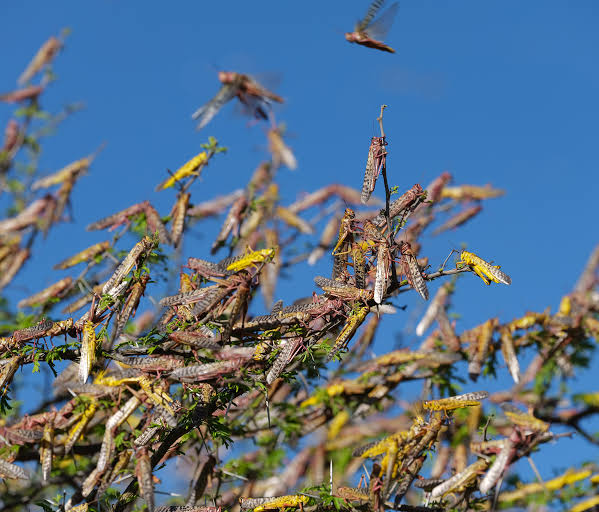
Somalia has declared a state of emergency over a locust invasion that is threatening to devour crops that were due for harvest from April.
Said Hussein Lid, Somalia’s Minister for Agriculture and Irrigation, said the government has identified a large invasion in the southern federal states of Hirshabelle, South West and Jubbaland.
The declaration, The Nation reports, means Somalia is seeking targeted funding and efforts to tame swarms attacking a region that is already food poor, according to a situational report by the UN Office for the Coordination of Humanitarian Affairs (UNOCHA).
The decision came on Thursday after Mr Lid met with representatives of the Food and Agriculture Organisation and ministers from the three southern states of Somalia.
The officials “acknowledged the need to amplify efforts in the coming weeks and months, to mitigate damage in food security and livelihoods in Somalia due to desert locust infestation,” said a bulletin issued on Thursday.
Somalia is the first country in the region to declare a state of emergency, even though the locusts have ravaged most of the Horn of Africa region.
In Kenya, officials said at least 15 of the 47 counties had been affected since the second wave of invasion began in November. They include Garissa, Wajir and Mandera which border Somalia’s south-western region. However, unlike Somalia, Kenya has been able to make aerial sprays on farms, targeting to kill the insects before they could jump to other fields.
Peter Munya, the Kenyan Cabinet Secretary for Agriculture, said 75 different swarms entered Kenya from Somalia and Ethiopia and authorities had dissipated 66 of them in an area of about 19,000 hectares using nine aircraft.
“Funding is needed to increase control efforts over the coming months, with sustained efforts needed in Northern and Central Somalia as we monitor the development of potential new swarms,” said a joint statement by the FAO and Somalia government officials on Thursday.
Officials said the risk of crop damage for 2021 “remains high and alarming” from the desert locusts.
FAO says it may need up to $38 million to keep the planes spraying chemicals in Kenya and Somalia.


A vote for Raila Odinga will address Africa’s prosperity promptly.


Many Happy Returns To Princess Adeshewa Loveth


Dozens Trapped As Four-storey Building Collapse In Abuja


Rhema Voice Chapel International Sierra Leone Turns Sod To A Magnificent Church Building

