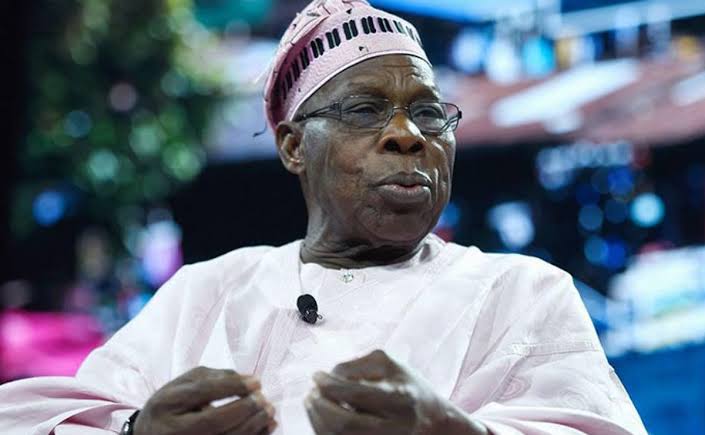
Olusegun Obasanjo, a former president, claimed on Friday that the terrorist organization’s founders told him that poverty and unemployment were what inspired Boko Haram members to commit crimes during the early stages of the North-East struggle.
However, he cautioned that if the nearly 20 million children who are not in school are not immediately addressed, they will serve as a breeding ground for future members of Boko Haram.
At an event in Lagos, he made these remarks at the book launch for “Pillars of Statecraft: Nation-Building in a Changing World,” written by his daughter, Dr. Kofo Obasanjo-Blackshire.
In response to a query from a member of the audience about why recent government measures had become more political than people-centered, he stated one of the main issues facing the nation was the search for scapegoats for its difficulties.
He stated further, “During the early days of Boko Haram, when the man who started the movement was said to have been killed, I said I wanted to meet with the members of the group to talk to them and know what they wanted.
“I met with their representatives and found out that they needed nothing but a better life for themselves. Can we blame them for wanting a better life for themselves?
“They said they believed in Sharia Law. I told them that Sharia was not a problem in Nigeria. It is part of our constitution.”
The former president claims that several of the rebel group’s members admitted to him that they had attended college but were jobless.
He added, “Do we blame them if after four years, they have no jobs? Are they not entitled to a livelihood? This boils down to one of the P’s of nation-building – politics – which talks about governance and leadership.
“If that (leadership) is not properly taken care of, every other thing will go haywire,” he said.
He also added that Nigerians must learn to face their own problems squarely rather than blaming others for it.
He said, “We must ask, ‘What do we do with our people? How do we raise and value them? How do we value them?’
“We have over 20 million out-of-school children. Google how many countries in the world have less than 20m. That doesn’t worry us? Are you thinking there will be no Boko Haram tomorrow?
“Those are the foundations of your Boko Haram tomorrow. That should be our concern. We should not say it is externally induced. Is poverty also externally induced? Poverty is the conscious, unconscious choice of our leaders. If we say no; it would be no. If we say yes; it would be yes.”
The elder statesman, Obasanjo, who participated in the panel discussion, emphasized what he called “The Five P’s of Nation-Building,” or population, prosperity, protection, politics, and partnerships.
In response to Kofo’s introduction of the sixth P, prayer and pleasing God, and the question of whether Nigeria had become failed, failing, or weak, he remarked, “I take the situation of our states at this time as work-in-progress. Before we complete the statehood process, we are powerless to take any action.
Obasanjo claimed that the West was aware of Nigeria’s flaws and that when leaders reveal those weaknesses, they take advantage of them. He cited an encounter he had with a previous World Bank President while serving as Nigeria’s military head of state.
He added, “There is a level of fragility in every state. No state is perfect, even America. I used to joke with my American friends that God gave them Trump to show that they are humans as well, and we are, more or less, the same.”
He continued by saying that in order for Nigeria’s democracy to function, the nation must learn how to manage its variety. He also said that all other types of administration, such as autocracy, plutocracy, gerontocracy, etc., do not last for very long.
Kofo, in her remark, noted that she had embarked on the course based on the advice of her father during a trip in 2017 after expressing a desire to serve others.
She stated, “As a young adult, I was incensed at the injustice and persistent corruption I observed in Nigeria. The disparity between the nation’s resources and the living standards of the average Nigerian brought me to my feet in outrage and frustration during conversations,” she said.