admin, Author at The Lafete Magazine | Page 333 of 398
close

admin

News & Announcements

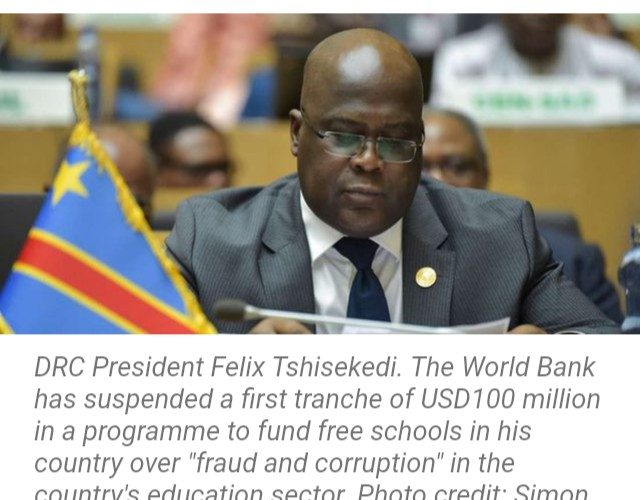
World Bank Suspends $100m Education Grant To DRC Over Corruption

The World Bank said Tuesday it was suspending the first tranche of USD100 million in a programme to fund free schools in the Democratic Republic of Congo over “fraud and corruption” in the country’s education sector.

Directors at the development lender had signed off last year on USD800 million of funding for free primary schooling, a flagship project of President Felix Tshisekedi.

But in a report published in November, the DRC’s Inspector General of Finances “revealed a number of shortcomings and alleged cases of fraud and corruption in connection with the use of public funds in the sector, as well as weaknesses in internal controls,” the World Bank said in a statement.

“The disbursement scheduled for December is currently on hold, while the World Bank similarly exercises its own fiduciary responsibility,” the institution added, saying it was “working closely with the Congolese authorities”.

In its report, the IGF said it found fake invoices, lists of teachers stuffed with fake names at non-existent schools, as well as the suspected embezzlement of 63 billion Congolese francs ($31 million).

Trade union sources told AFP that two senior civil servants in the education system singled out by the report, including the head of teachers’ payroll, were in pre-trial detention.

“These two added large numbers of non-teachers to the payroll system on a regular basis,” said Jean-Bosco Puna of the National Catholic Teachers’ Union.

Tshisekedi’s education push saw four million new pupils sign up during the 2019-20 academic year, although the coronavirus pandemic forced a pause in teaching for six months.

Schools and universities had to close for a second time in December after reopening two months before.

The free schools’ programme was estimated to cost USD2.6 billion when it was launched, more than one-third of the DRC’s annual budget for 2021 — even as other public goods like hospitals and roads are lacking.

Most of the DRC’s 87 million people are under the age of 20.
read more
News & Announcements

Ethiopian Tigray Region Facing Acute Food Problem After War

Ethiopia’s Tigray region may be facing a new chapter of starvation and deaths, the aftermath of a conflict that began last November, to crackdown on an erstwhile ruling party.

Multiple sources from the restive region have confirmed food shortages, forcing many displaced people to go days without eating.

Internally displaced persons (IDPs) who recently fled to the regional capital Mekelle, from war zones in western Tigray, said people, mainly women and children, are dying of malnutrition and disease, suffering severe food and water shortages and lacking medical care.

“Food and non-food items or other necessities and personal properties have been looted or destroyed” said one IDP who fled her home town in Shire, western Tigray.

Abrehet, a mother of two, owned a shop before the conflict erupted and now has nothing left to support her family.

“I have lost everything. All my properties in the shop and in my home were looted. I had to run for my life” She told the Nation on phone.

“I came to Mekelle alongside a group of Shire residents looking for food aid as there is no humanitarian aid in and around our town” she added.

Abrehet’s story reflects that of most people in Tigray as thousands were displaced by the conflict.

In addition to the lack of food, the lack of clothing and hygiene has made life difficult for women temporarily sheltered at school compounds in Mekelle and other areas.

A United Nations situational report said last week some 4.5 million people in the Tigray region are in need of emergency food assistance.

The details of starvation first arose earlier in January after a note from the interim administration official was leaked to the media. He admitted that “hundreds of thousands of people could starve to death in Tigray”.

The government-run Tigray Emergency Coordination Center (ECC) conducted a study on the level of humanitarian need following the conflict in the region.

According to the leaked notes taken by a participant at an ECC meeting, an official from the interim administration of the central part of Tigray said the situation is dire.

“Unless urgent emergency assistance is mobilized, hundreds of thousands might starve to death. People are dying because of starvation. In Adwa town, people are dying in their sleep,” the official was quoted as saying.

“During a visit to various places, our escorts were asked for a single biscuit,” the official added.

In public, this is a story the Ethiopian government has tried to beat down by either downplaying its magnitude or blaming the atrocities on fighters in the Tigray People’s Liberation Front.

Prime Minister Abiy Ahmed’s office said last week that it had delivered 31,000 tons of food and other emergency supplies to civilians since January 1.

“The government is putting in place necessary protocols to protect civilians, stabilise the region and capture the remaining suspects of treasonous crimes,” the office said in a statement on January 25.

Members of the Afar Special Forces prepare their weapons next to a damaged house in the outskirts of the village of Bisober, Tigray Region, Ethiopia, on December 9, 2020.

In November, he authorised the Ethiopian National Defence Forces to go for the fighters after they allegedly attacked a northern command of the national military.

Dr. Abiy declared three weeks later that the “law enforcement operation” had been completed. But fighting has gone on in areas in the mountains, forcing many more civilians to flee. 

“In this complicated and high stakes operation, humanitarian, diplomatic and media agencies will have to endure the inconvenience of heeding to the direction of the government,” the Prime Minister’s Emergency Response Taskforce, headed by Redwan Hussein, said in a statement last week.

It was the same time the head of the UN Refugees Agency (UNHCR), Filippo Grandi, toured Makelle with Ethiopian Minister for Peace, Muferihat Kamil.

On January 21, Grandi said in a statement that Tigray was experiencing “major violations of international law at refugee camps”.

According to aid agencies, there are no health care services outside the Mekelle and some people are dying of pneumonia and mishandled childbirth.

Despite efforts to provide medical care, IDPs who spoke to the Nation said there is a severe shortage of medicine.

The IDPs said the pharmacies that exist ere generous enough to provide free medical care and that some hospitals were providing limited services, but also noted shortages of medicines.

Aid workers, who visited rural areas of Adigrat and Axum towns, saw doctors and nurses struggling to keep “starving patients” alive, but the city’s main hospital ambulances were stolen, Reuters reported.

The United Nations Children’s Fund (Unicef) said that there were “severe medical shortages” at clinics in Shire town and that the situation was worsening.

Telephone and internet blackouts in most parts of Tigray, has made it difficult to verify reports outside the regional capital.

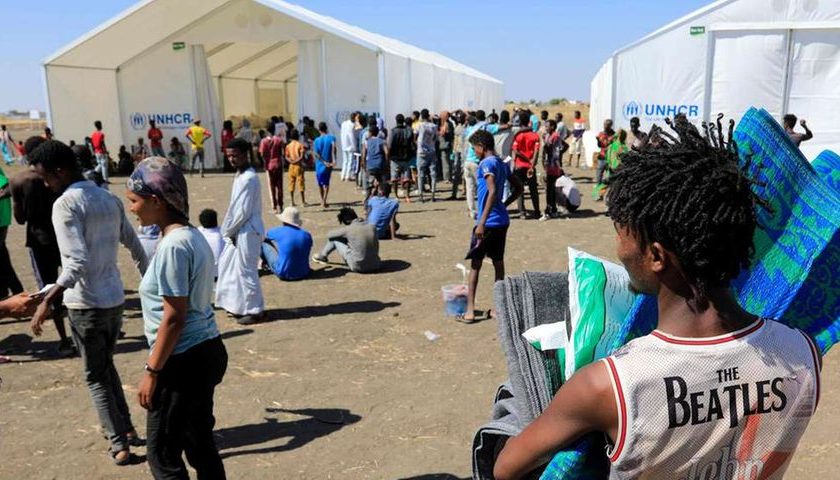
Ethiopians, who fled the Ethiopia’s Tigray conflict as refugees, wait to charge their smart phones at Um Raquba refugee camp in Gedaref, eastern Sudan, on December 1, 2020. 

The federal government’s military operation in Tigray ended in late November after the federal forces took control of Mekelle ousting the TPLF, the former regional ruling party.

The security situation in the area remains unstable after more than two months of a confrontation between Ethiopian National Defence Forces (ENDF) and forces loyal to TPLF.

Although there have been some improvements, there are reports of continued fighting in the central, eastern, northwestern, south and southeastern parts of the region, with some rural areas remaining highly insecure.

According to the UN, access to some areas of Tigray remains limited, but some assistance is being received despite security issues.

Humanitarians keep calling on the government to grant unrestricted and unhindered access to the areas affected by the conflict.

“Although access to the affected region has increased, with food and other humanitarian commodities entering the region, the need still greatly exceeds the assistance provided” said International Medical Corps, one of the few organisations that has been able to access communities in West Tigray.

Electricity, banking and public transport are slowly being restored but remain severely limited and communication networks are still largely cut off.

read more
1 331 332 333 334 335 398
Page 333 of 398